Todays take home message: buy Fairtrade if you don’t already. A lot of sweat, and yes, blood goes into that cup of coffee. Bear with me here…
On our arrival in Costa Rica back in January, some Spanish lessons were our first priority. I have travelled briefly in Spain before, but I was thwarted in my efforts to communicate by, frankly, laziness. Cue much embarrassing mime, pronunciation that made the locals’ skin crawl, and blank staring. This time I would be a good student. As a bonus, the school that we attended worked with a variety of local organizations that would willingly provide a venue for students wanting to practice, in exchange for volunteer work. I therefore was delighted to head off to the botanical garden collections and coffee germplasm facility at CATIE, the tropical agronomic research station in Turrialba.
Second only in size to a facility in Ethiopia (coffee’s homeland), the CATIE coffee “finca” is a superstore of the genetic diversity of 2,500 different varieties of coffee from all over the world. This facility is crucial, as it acts as an insurance policy for the coffee business, providing the ability to breed for resistance to a variety of pests and to develop new strains that will be able to cope with the rapidly changing climate in the latitudes where the “golden bean” grows.
Volunteering at CATIE gave me the opportunity to learn what goes into making great coffee, well before it reaches a barista, while practicing my improving Spanish. But I hadn’t fully grasped how tricky the rural accent is! For me the likelihood of coming away from this speaking fluently was going to be like dropping a German on a Newfoundland lobster boat and expecting them to learn BBC English.
While working at CATIE I got involved with a range of the seasonal work involved in growing coffee. When the bushes are first planted, they are nursed by a crop of Canavalia beans. Also known as Jack beans, these legumes grow incredibly fast, acting as a nitrogen- and potassium-fixing living mulch, outcompeting other weeds among the young coffee bushes. Most of the nitrogen for the plants’ early years is courtesy of the Canavalia.
-
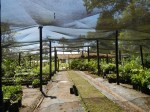
- Coffee nursery
-

- Pruned coffee
-
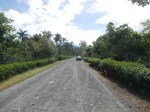
- Catie coffee farm
The coffee beans themselves ripen slowly, needing shade, provided here by the Poró tree. After harvest by hand, the beans go off to be processed – which is another whole fascinating business – and then the plants need to be pruned. Old dead wood is removed, and the plants are thinned down to 4 or 5 good growing stems from the last years’ growth. All residues are left to rot on the ground. At CATIE, their soil pH requires them to lime annually, which also provides a fringe benefit. By tossing the required dose of powdered dolomite into the canopy of the plants, foliar pests are reduced and there is some foliar uptake of calcium before the rest is washed into the soil with the next rain.
Following this the shade trees need to be pruned to keep them manageable. Poró is incredibly fast growing with a pulpy, watery wood and vicious thorns. They are grown as pollards about 8-10 feet high, and every year most of the branches are removed, leaving some for dappled shade while the others grow back. The branches are hacked off from ladders by machete, chopped up and used as mulch on the ground, breaking down surprisingly quickly despite the girth of some of them. They also contain a lot of native bees’ nests. I pretty quickly learned to sprint away through a minefield of brush and stumps!
Add to this a constant cycle of mowing in the organic crop and spraying weeds among the conventionally grown plants and you have yourself a pretty busy year.
Now, a razor-sharp machete is the tool of choice for your average work day on a coffee farm. It is a versatile, highly efficient tool that, in skilled hands, performs jobs ranging from tree pruning to tooth pick. What it also is, in less skilled hands, is a rather messy means of not only trimming your thumbnails, but also a small portion of thumb itself. While pruning a bush one morning with my mind elsewhere, the inevitable happened. The missing piece of thumb-meat was gone and would provide a good protein source for the ants, so I dripped my way over to Luis the foreman, and explained in my finest Spanish what had happened. The long and the short of it is that having been patched up, they kept me away from machetes for a while. They reckoned I could be trusted with a spade at least, and so I was re-assigned to their compost program. This turned out to be a great blessing in disguise; some more about that another day.
Sam
-

- Chemical fertilizer
-

- Riding to work in the coffee plantation, Costa Rica



 Two Roads Farm